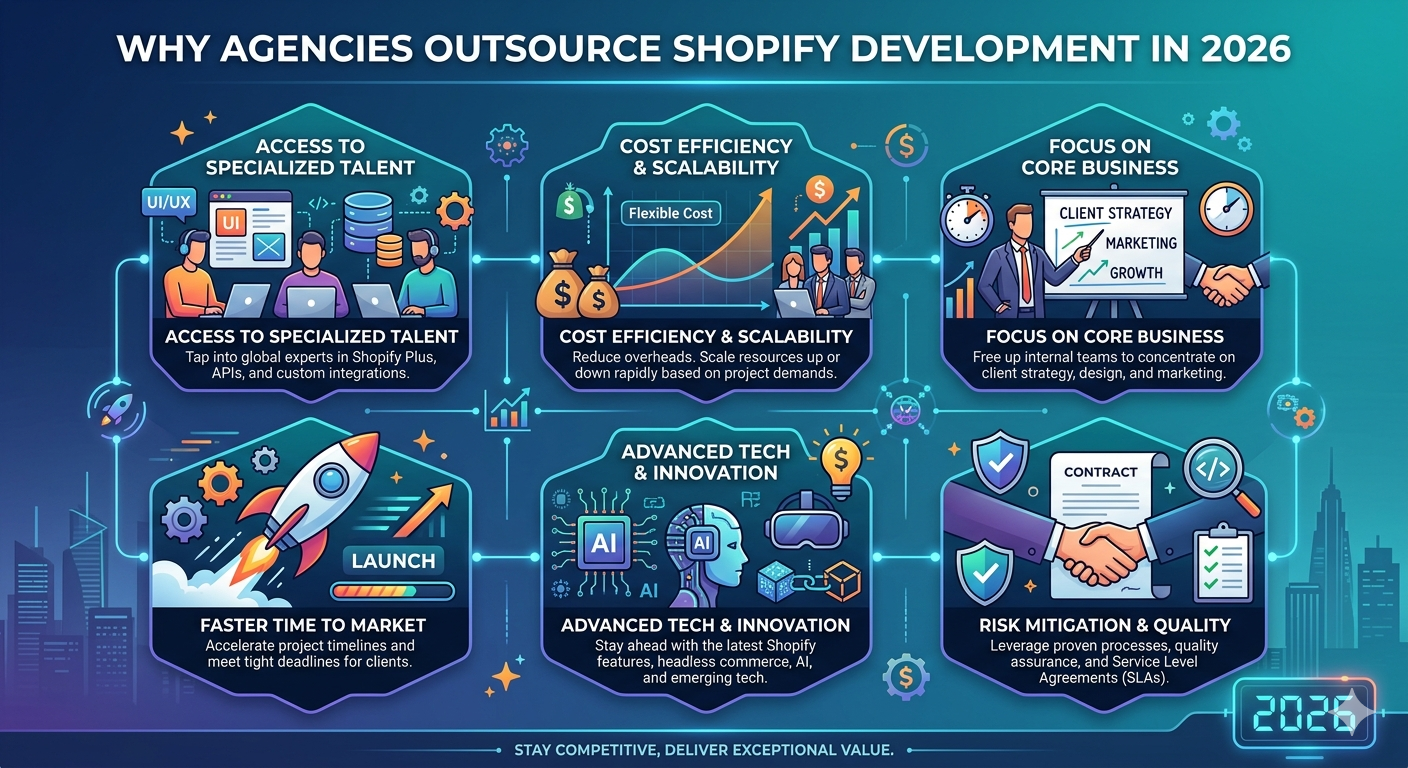
The digital agency landscape in 2026 is defined by an ongoing battle for operational efficiency. Enterprise D2C brands no longer accept standard templates or basic configurations. They demand custom, highly performant storefronts, complex API integrations (ERPs like NetSuite and SAP), headless architectures (Hydrogen/Oxygen), and advanced Shopify Functions built using checkout extensibility rules. For creative, SEO, and marketing agencies, maintaining a highly paid internal development department to handle these complex requirements represents a massive financial and operational burden.
Retaining senior Liquid and React engineers limits your scaling potential and increases delivery risks. When developers leave or resources are stretched across multiple launches, build quality drops, launches are delayed, and client retention suffers. This is why leading agencies across the US, UK, and UAE are transitioning to strategic white-label partnerships. By utilizing a dedicated shopify development partner, agencies can leverage elite engineering benches to expand their capabilities, secure profit margins, and focus on strategy. Discover more on how Zest functions as a leading silent partner at our agency partner model page.
How to Choose a White Label Shopify Development Partner?
When evaluating a white-label Shopify development partner, agencies must prioritize three critical criteria: **technical capabilities** (proven track record in Checkout Extensibility, custom apps, Hydrogen React, and dynamic integrations), **operational security** (strict B2B NDA protocols and direct communication models within Slack or Jira under your brand name), and **guaranteed SLAs** (predefined response times, robust in-house QA, and redundant developer benches to eliminate launch delays).
1. The Core Strategic Agency Partnership Models
Fulfillment flow within growing agencies is rarely static. You may win multiple enterprise migration builds in a single month, followed by a quiet quarter. A premium partnership model provides the flexibility required to adjust capacity without carrying unbilled overhead.
Model 1: Project-Based Collaboration: Best for fixed-scope projects such as migrations, custom theme rebuilds, or headless deployments. We scope the requirements, estimate development hours, establish milestones, and deliver a fully quality-assured storefront, allowing you to secure profit margins without delivery risk.
Model 2: Dedicated Developer Retainer: Assigns a dedicated senior Liquid or React engineer directly to your agency for 20 to 40 hours per week. This engineer integrates into your Slack and Jira workspaces, acting as your silent, in-house technical department to execute complex support tasks.
Model 3: Follow-the-Sun Timezone Pipeline: We utilize timezone offsets as an operational asset. UK and US agencies can brief a technical task or bug ticket at the end of their business day and wake up the next morning to find the work completely built, tested, and ready for client review.
2. Seamless White-Label Delivery & Communication Workflows
Communication gaps ruin complex projects. A true white-label partner operates as a silent engine behind the scenes under your brand. We maintain total client confidentiality through strict B2B NDA protocols and direct channel integration.
We work completely within your ecosystem. All code updates, Slack check-ins, and ticket updates are handled using your agency's domain profiles or email systems, maintaining brand consistency and client trust. Our senior developers join your client syncs as your silent, expert advisors, helping you scope work and win large pitches with technical authority.
Additionally, we maintain a dedicated in-house Quality Assurance (QA) team. Every page layout, checkout rule, and visual frame undergoes rigorous cross-device, speed, and regression testing in staging environments before any code is pushed to production. This ensures that every deliverable is flawless before it ever reaches your desk.
3. Pricing, Profit Margins, and Scaling Fulfillment
In-house developers eat into project margins. The hiring process, payroll taxes, benefits, and unbilled downtime limit agency profitability. Partnering with a white-label agency in an optimized tech hub allows you to significantly reduce execution costs while maintaining premium build standards.
Financial Margin Comparison: In-House vs. White-Label Development
| Cost Element | In-House Developer Model | White-Label Partner Model |
|---|---|---|
| Average Annual Cost | $120,000 - $150,000 (Base + Overhead) | $45,000 - $65,000 (Retainer/Project-based) |
| Elastic Capacity | Fixed (Unbilled downtime limits margins) | Dynamic (Scale developer bench up or down instantly) |
| QA & Project Management | Additional payroll burden ($60,000/yr) | Included in delivery rates |
| Typical Profit Margins | 15% - 25% | 45% - 60% |
4. The Risks of Freelancers vs. Dedicated Agency Partners
Relying on freelance Shopify developers is a severe single-point-of-failure risk. Freelancers often suffer from volatile availability, lack structured QA support, and struggle with enterprise updates like Shopify Checkout Extensibility.
If a freelancer goes silent in the middle of an enterprise migration, the agency faces catastrophic delays. A dedicated agency partner provides redundant developer benches, robust SLAs, and strict NDA protocols. This ensures your projects always have uninterrupted access to redundant, highly skilled developers who can maintain momentum.
Furthermore, e-commerce technology shifts rapidly, with core updates occurring multiple times a year. When you partner with a specialized team, you offload this entire training burden. Your partner handles all research and development, allowing your agency to immediately sell new technical features to your clients without investing resources in developer retraining programs.
5. Case Studies: Strategic Partnership in Action
To see the real-world impact of this white-label model, let's examine two typical agency success stories:
Case Study 1: boutique Manhattan Design Agency Scales Capacity
A high-end design agency based in New York was turning away large Shopify Plus clients because their small, in-house team was overwhelmed by custom backend requirements and API integrations. They were carrying heavy overhead yet struggling to hit launch dates, resulting in client friction.
By establishing a strategic white label shopify services partnership with Zest, they offloaded 100% of their complex backend execution, Liquid styling, and QA steps. Within six months, the agency successfully launched four major enterprise-grade sites, boosted project capacity by 200%, reduced development costs by 45%, and scaled client satisfaction scores to an all-time high.
Case Study 2: London Marketing Agency Dominates Headless E-commerce
A marketing agency based in London wanted to offer sub-second headless Shopify builds to their fashion D2C clients to combat rising ad acquisition costs, but they lacked Hydrogen/Oxygen React capabilities internally. Finding senior React developers in London was prohibitively expensive.
They partnered with Zest as their backend shopify outsourcing partner. Zest custom-engineered performant headless storefronts, delivering sub-second load times and 95+ PageSpeed scores. The agency successfully upsold headless services to their active clients, securing high-ticket contracts and expanding their net operating margins by 50% without hiring a single local developer.
Conclusion
Decoupled development, API integrations, and checkout extensions require deep, specialized talent. For scaling digital agencies, maintaining this level of engineering expertise in-house is not feasible. This is why leading agencies choose to work with a dedicated white label shopify partner like Zest.
By offloading the technical execution to our silent development team under a strict NDA, you can offer enterprise-grade Shopify platforms to your clients, increase project margins, and eliminate technical debt. Connect with our senior engineering team today to start building your brand's technical advantage.