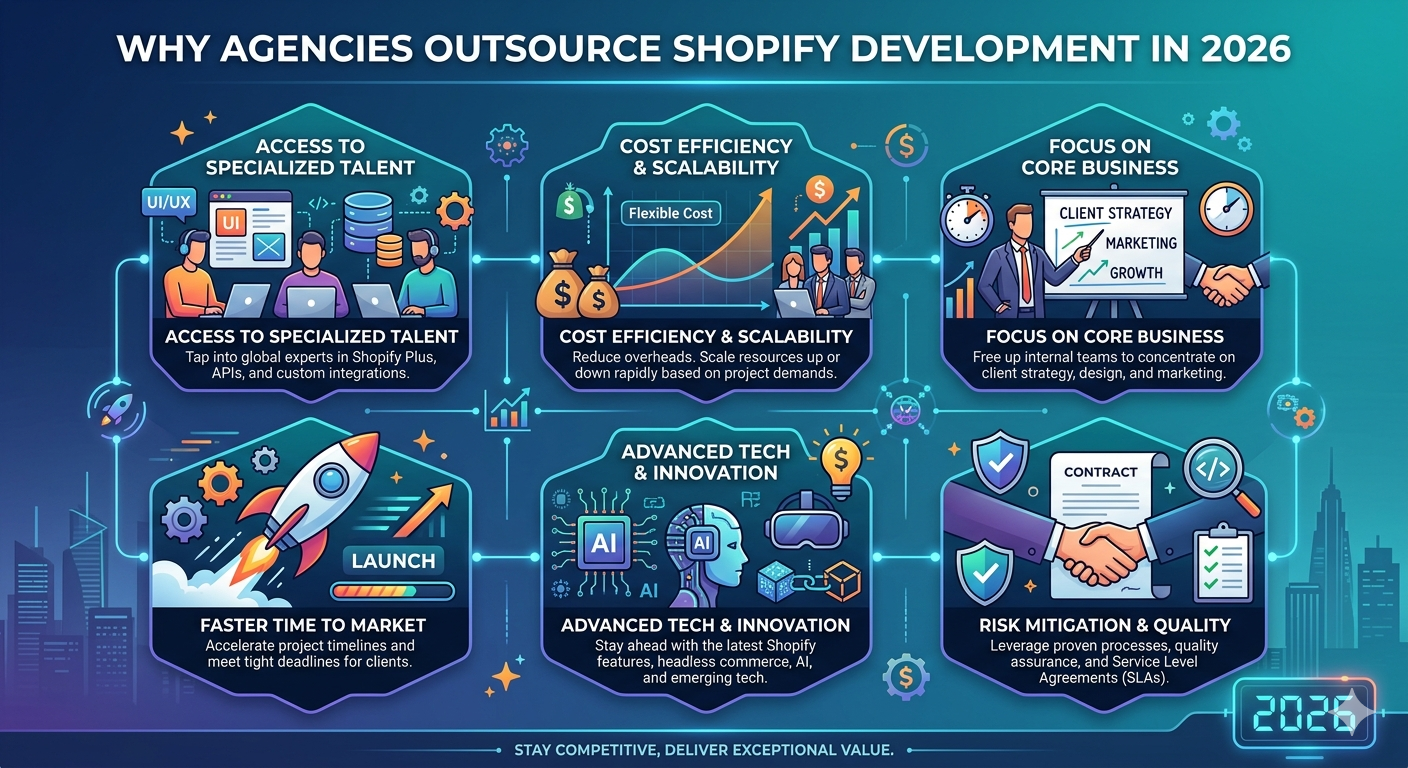
The global e-commerce development landscape in 2026 has reached a point of extreme complexity. Online merchants no longer buy simple, templated retail solutions. Enterprise e-commerce brands demand lightning-fast, custom storefront architectures, complex backend application integrations, sub-second global edge network distribution, and advanced checkout personalizations. For creative agencies, SEO teams, digital marketing groups, and growth studios, meeting these demands requires substantial, specialized engineering resources.
As agency pipelines expand, agency owners and directors of operations face a fundamental structural choice: Do you invest heavy capital into recruiting, training, and retaining an internal engineering department, or do you leverage a specialized shopify development partner to handle backend fulfillment under a silent, NDA-protected framework? The decision is not merely about developer headcounts; it determines your net operating margins, delivery predictability, and overall organizational risk.
1. Introduction: The Capacity Bottleneck for Scaling Agencies
Maintaining execution capability is the primary operational friction point for modern marketing and creative agencies. While your core team excels at brand strategy, user interface design (UI/UX), data analytics, and search engine acquisition, translating those visual concepts and growth strategies into stable, production-ready code is a highly complex process. When client projects require advanced Shopify configurations, backend engineering is often where timelines slip, budgets are blown, and relationships fail.
In 2026, e-commerce has evolved past standard Liquid development. Digital storefronts must integrate with complex third-party ERPs, CRM platforms (like Salesforce, Hubspot, or Microsoft Dynamics), warehouse management systems, and specialized subscription architectures. Attempting to manage these complex configurations using a small, generalist in-house team causes immediate delivery bottlenecks. The question is how to scale engineering output efficiently. For most agencies, relying on a dedicated shopify development agency to act as their silent engineering arm has become the most effective mechanism to eliminate technical risk and focus on high-ticket client relationships.
2. The Hidden Cost of Hiring In-House Shopify Developers
On paper, hiring in-house developers seems like a natural way to maintain direct control over quality and timelines. However, when evaluating the financial reality of recruitment, the actual cost of a full-time employee is far higher than their base salary. For agencies operating in high-cost regions like the United States, the UK, or Western Europe, the fully loaded cost of an internal developer includes several significant hidden expenses:
| Cost Element | In-House Developer Model | White-Label Partner Model |
|---|---|---|
| Recruitment Fees | High (15-20% of salary, or recruiter hours) | Zero ($0 upfront setup) |
| Onboarding Latency | 30-90 days of non-billable training | Immediate kickoff (pre-vetted team) |
| Operational Overhead | Office, MacBooks, licenses, benefits, taxes | Zero (fully absorbed by partner) |
| Unbilled Idle Time | Fixed cost during pipeline dry spells | Variable billing (pay only for active work) |
| Talent Retention Risk | High (employee churn halts project delivery) | Zero (continuous team redundancies) |
- Recruitment and Sourcing Costs: Finding top-tier talent is an expensive process. Recruitment placement fees often exceed 15% to 20% of a developer's annual salary. Additionally, senior leadership (founders, directors, CTOs) must spend valuable billable hours reviewing code samples, screening portfolios, and conducting multiple rounds of technical interviews.
- Onboarding & Ramp-Up Deadweight: A developer rarely generates net positive margins during their first 30 to 90 days. They must get acclimated to the agency's tech stack, Git flows, deployment protocols, and specific client histories. During this time, they require active supervision from your existing senior staff, reducing the productivity of your highest earners.
- Tooling, Licensing, and Hardware Provisions: To perform their jobs, engineers require premium laptops (such as Apple MacBooks), high-speed development setups, and multiple software subscriptions. Licenses for Git repositories, testing sandboxes, project management seats, IDEs, code editors, and staging environments accumulate significant monthly operational overhead.
- Employee Retention and Turnover Volatility: The tech employment market remains highly volatile in 2026. Developer turnover is a constant issue. When an in-house Shopify developer suddenly resigns to accept another offer, they take critical project knowledge with them. Replacing them requires repeating the recruitment cycle, causing missed project deadlines and damaging client trust.
- The Inevitable Skill Gap: E-commerce engineering is not a single discipline. To build an enterprise-level storefront, you need a developer who understands frontend styling, custom Liquid themes, backend Node/React architectures for Shopify applications, GraphQL query design, database management, PageSpeed optimization, and technical SEO structure. It is almost impossible to find a single hire who possesses elite competence across all these fields. Hiring one developer leaves immediate skill gaps, forcing you to either hire more headcount or compromise build quality.
3. The Scaling Problem: Fluctuating Workloads and the Capacity Trap
The primary systemic challenge of the agency business model is pipeline fluctuation. Client contract cycles are rarely flat. An agency might secure three major migrations and custom builds in a single month, requiring immense development bandwidth. Three months later, those builds launch, and the workload shifts to lighter digital marketing or search engine optimization retainers, leaving the development team under-allocated.
This dynamic creates a difficult operational challenge. If you hire a full-time in-house engineering team to handle peak capacity, your margins collapse during quiet periods due to unbilled bench downtime. Conversely, if you keep your internal team lean to minimize overhead, you face severe bottlenecks when project volume increases. Over-allocated developers become burnt out, leading to bugs, missed deadlines, delayed project launches, and client churn.
This is the capacity trap. It restricts agency growth, as agency sales teams are forced to slow down client acquisition out of fear that they lack the engineering resources to execute new projects. This artificial bottleneck stops agencies from scaling and allows more agile competitors to win valuable accounts.
4. The Advantages of White Label Shopify Development
Leveraging a specialized white label shopify development partner resolves these operational inefficiencies by shifting your engineering cost structure from a high fixed expense to a highly flexible, variable model. It provides several clear strategic benefits for scaling agencies:
- Elastic Scalability: Your development capacity becomes virtually unlimited and scales dynamically with your pipeline. When you win multiple enterprise migrations, your white-label partner allocates additional senior engineers to your account. When project volume drops, you scale back down, ensuring you never pay for idle bench time.
- Comprehensive Technical Expertise: A premium white-label agency maintains a deep bench of pre-vetted specialists. Your projects are staffed by dedicated developers suited for each task—from Liquid theme optimization and frontend CSS styling to custom React apps, GraphQL setups, and headless Hydrogen environments. You no longer have to rely on a single developer to do everything.
- Lower Operational Cost Structure: Offload the financial burden of HR management, employee benefits, hardware sourcing, and ongoing training. By partnering with a specialized technical agency in a key technology hub like India, you can leverage high-end talent at a much lower blended hourly rate, allowing you to price projects competitively while expanding your net margin.
- Accelerated Project Delivery: White-label partnerships allow you to run a 24-hour development cycle. Your US or UK team can prepare client designs, site maps, and developer briefs during the day and assign them. The development team executes the builds, carries out QA checks, and pushes the code to staging overnight. Your project managers wake up to completed tasks ready for review, cutting build times in half.
- Predictable Execution: Professional partners work with strict Service Level Agreements (SLAs). They utilize standardized Git flows, conduct thorough internal code reviews, and employ dedicated quality assurance (QA) specialists. This ensures that the code delivered to your team is clean and functional, reducing the QA burden on your account managers.
5. NDA-Based Agency Partnerships: Maintaining Brand Integrity and Trust
One of the main concerns agency owners have about using a shopify outsourcing model is protecting client relationships. They worry that a vendor might bypass them, contact clients directly, or deliver low-quality code that damages the agency's reputation. This is why a professional white-label partnership must be built on strict non-disclosure protocols and invisible fulfillment models.
A true white-label agency acts as a silent, high-performance engine running in the background. They do not claim ownership of the client relationship, use your client work in their public portfolios, or contact your clients. Under a formal NDA-based partnership, all engineering fulfillment is executed under your agency's brand:
"The client never knows our team exists. We build the site, write the integrations, and run the performance audits—but the credit remains 100% yours."
To ensure this invisibility, a premium partner integrates directly into your native workflows. All developers communicate using your internal channels—such as custom email addresses under your agency's domain, dedicated Slack workspaces, or project management boards in Jira, ClickUp, or Asana. All code commits are pushed to your GitHub or GitLab accounts under your team's profiles. This creates a cohesive setup where your client receives high-performance engineering while your agency retains complete brand equity, client control, and high margins.
6. Strategic Use Cases: When Shopify Outsourcing Makes Commercial Sense
Outsourcing is not an all-or-nothing decision. For many successful agencies, leveraging a shopify agency partner is a targeted decision applied to specific scenarios where it provides a clear operational advantage:
- Handling Development Overflow: During high-volume periods, such as preparation for Black Friday Cyber Monday (BFCM) in Q3 and Q4, development queues fill up fast. Outsourcing helps you manage this overflow without hiring full-time employees who might be under-allocated in Q1.
- Enterprise Shopify Plus Migrations: Replatforming clients from complex legacy platforms (such as Adobe Commerce/Magento, Salesforce Commerce Cloud, or SAP) requires custom data migrations, multi-system ERP syncing, and custom checkout flows. A specialized technical partner ensures these complex migrations are executed with minimal downtime.
- Custom Theme and Theme App Extensions: Creating lightweight, custom Shopify themes from scratch using the OS 2.0 architecture demands deep Liquid expertise. A white-label partner can quickly develop responsive, accessible themes based on your Figma designs.
- Shopify Checkout Extensibility & Functions: With legacy checkout scripts deprecated, custom discount logic, payment methods, and shipping rules must be built using Shopify Functions written in performant languages like Rust or JavaScript. This is a highly specialized skill set that a technical partner can readily supply. Learn more about performance configurations in our Shopify development services overview.
- Technical SEO Implementations: Simple changes to meta fields are easy, but fixing canonical logic, indexing traps, and duplicate product variants requires developer intervention. A specialized partner ensures these technical SEO fixes are executed cleanly. Read our detailed guide at Shopify Technical SEO checklist.
- Core Web Vitals & Speed Optimization: Slow site speed directly reduces client conversion rates. Technical partners can optimize images, defer render-blocking JavaScript, implement CSS minification, and configure advanced caching layers to improve Interaction to Next Paint (INP) and Largest Contentful Paint (LCP). Explore our optimization services and request a free website performance audit to see where speed bottlenecks exist.
7. When Hiring In-House Is the Correct Strategic Move
While white-label outsourcing offers significant financial and operational advantages, there are certain situations where hiring in-house developers is the better strategic choice. A balanced approach requires identifying these scenarios:
First, if your agency is building proprietary technology, such as a SaaS product, a custom app for the Shopify App Store, or unique intellectual property, you should maintain that development in-house. Building and retaining long-term technical value in your company requires full-time, internal developers who are aligned with your product roadmap and vision.
Second, if your agency focuses on a small number of high-value, long-term clients who require constant, real-time collaboration, an in-house engineering team makes sense. If your business model relies on developers participating in daily client stand-ups, brainstorming sessions, and ongoing operational meetings, the face-to-face contact of an internal team outweighs the cost savings of outsourcing.
Finally, if you have the financial resources to support a permanent development team during market downturns, and you are actively committed to building an engineering-first culture, hiring in-house is a viable strategy. If software engineering is your agency's core product, keeping that talent in-house is key to maintaining your brand identity.
8. The Hybrid Model: The Blueprint for Agency Growth
For most fast-growing digital agencies in 2026, the choice is not a simple binary between 100% in-house or 100% outsourced. Instead, they choose a hybrid approach that combines the strengths of both models. This hybrid structure is designed to maximize efficiency and protect project margins:
The Modern Hybrid Agency Structure
In-House Strategic Core
- Creative Directors & UI/UX Designers
- Account Managers & Client Leads
- Lead Solutions Architects
- Technical Project Managers
White-Label Execution Engine
- Senior Liquid & Theme Developers
- React, Remix & GraphQL Engineers
- Systems & ERP Integration Specialists
- Dedicated QA & Testing Teams
By keeping creative strategy, client communication, system architecture design, and technical project management in-house, your agency retains full control over the client relationship. Meanwhile, you offload the heavy coding, repetitive template updates, and QA testing to your white-label Shopify partner. This approach keeps your fixed overhead light, protects your operating margins, and allows you to pitch and deliver complex projects with confidence.
9. Operational Checklist Before Onboarding a Shopify Partner
If you decide to leverage a white-label partner, it is important to screen potential candidates carefully. Not all development agencies are the same, and choosing the wrong partner can lead to delayed launches and technical debt. Use this checklist to evaluate prospective partners:
- Technical Capabilities Assessment: Does the partner have deep experience with Shopify Plus, checkout customizations, API integrations, and headless setups using React, Remix, and Hydrogen? Review their case studies and request developer CVs to verify their expertise. (Review our client work at Zest e-commerce case studies).
- Clear Communication Channels: Can their developers integrate into your team's Slack, Microsoft Teams, or Jira? Do they provide regular project updates, and are their project managers available during your core working hours?
- Strict Legal Protections: Does the partner provide a comprehensive, legally binding NDA that protects your client relationships, codebases, and intellectual property? Do they guarantee that all IP transfers automatically to your agency?
- Dedicated Quality Assurance Processes: Does the developer handle testing, or do they expect your team to find bugs? Make sure your partner has a dedicated QA team that performs thorough testing across devices and browsers before delivering code.
- Trial Project Execution: Before signing a long-term retainer, run a small, scoped trial project—such as a custom landing page or a minor app integration. This helps you assess their communication, code quality, and delivery speed under realistic conditions.
10. Conclusion: Securing Your Delivery Engine for 2026
As e-commerce technology continues to advance, digital agencies must find ways to optimize their delivery workflows. Carrying the overhead of a large, local in-house engineering team is becoming a risky and expensive strategy for most boutique and mid-sized agencies. When developers resign, project capacity fluctuates, or skill gaps delay builds, your agency's profitability and reputation are on the line.
Partnering with a specialized white-label development agency offers a practical alternative. It allows you to scale your development capacity, access deep technical expertise, and reduce your operating costs. This shift enables your agency's leadership to focus on what you do best: branding, strategy, search engine acquisition, and building strong client relationships.
At Zest, we act as a dedicated **technical Shopify partner** for leading digital agencies across the United States, United Kingdom, and Europe. We operate under strict NDA protocols, delivering high-performance Shopify development, headless builds, and custom integrations behind the scenes. Contact our team to explore how we can support your agency's growth.